
Hosted by ValidiFI | Moderated by John Gordon, CEO
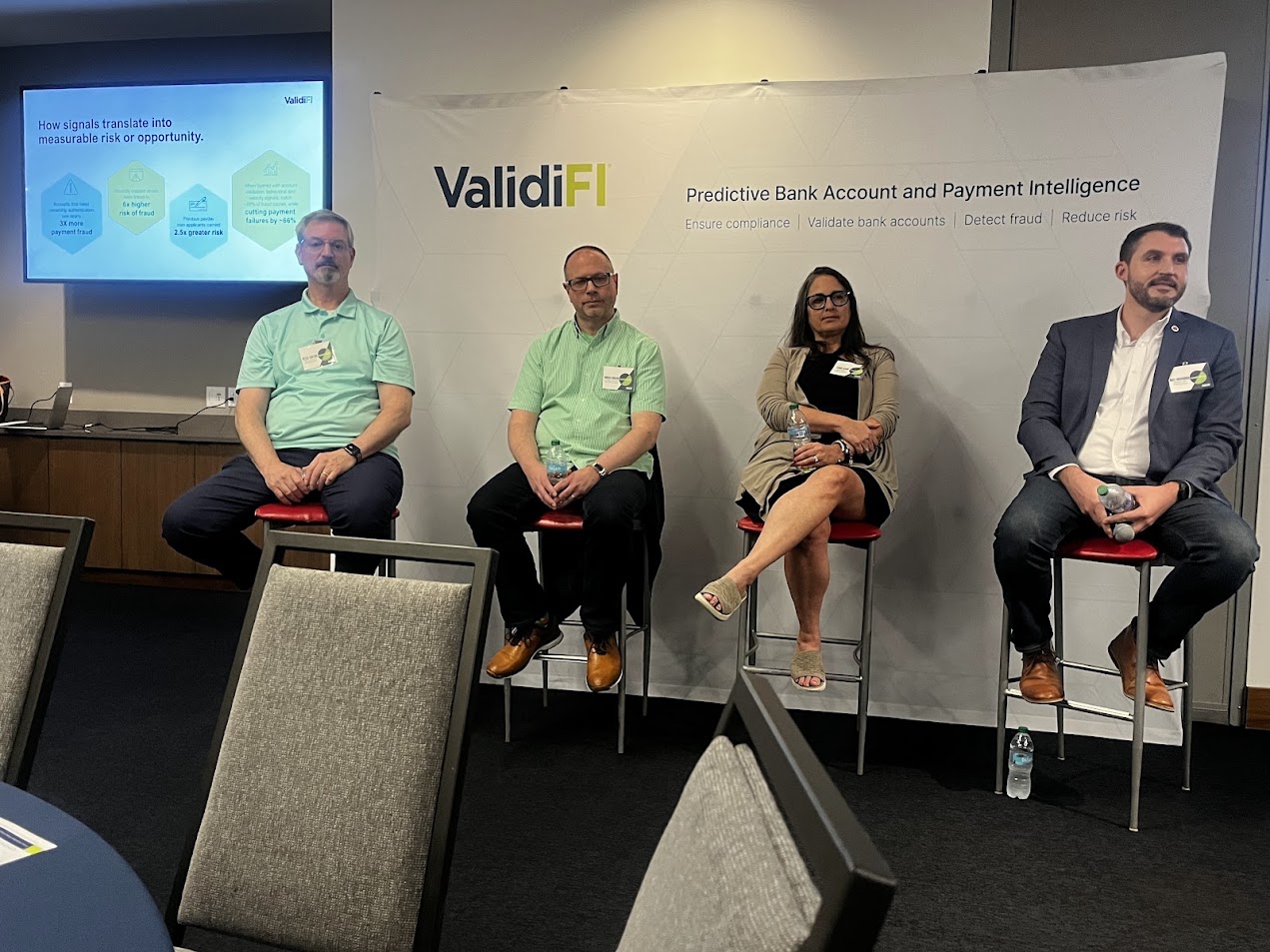
Featured panelists (left-right): Peter Tapling, Managing Director, PTap Advisory LLC; Doug Mihalow, Head of Fraud Strategy, Cambridge Savings Bank; Laura Clary, Senior Director Product Compliance, Abrigo; and Matt Rosebaugh, Executive Director, JPMorgan Chase
Fraud is evolving faster than ever.
From AI-powered phishing and business email compromise (BEC) attacks to synthetic identities and first-party fraud, today’s fraudsters are operating with greater sophistication, speed, and scale. At the same time, financial institutions face increasing pressure to strengthen fraud controls, comply with new Nacha requirements, and deliver seamless customer experiences.
These challenges took center stage during ValidiFI’s recent executive fraud roundtable, where industry experts explored emerging threats, fraud prevention strategies, regulatory expectations, and the future of risk management.
While the conversation covered a wide range of topics, one message surfaced repeatedly throughout the discussion:
There is no silver bullet for fraud prevention.
The most successful organizations combine data, technology, processes, governance, and human expertise into a layered strategy that continuously evolves as fraud evolves.
1. Fraud Prevention Starts Before the Payment
One of the strongest themes from the discussion was that fraud detection cannot begin when a payment is initiated.
As John Gordon noted, “An ounce of prevention is worth a pound of cure.”
The panel emphasized the importance of evaluating risk during onboarding and account setup, when organizations have the greatest opportunity to detect potential fraud before losses occur.
Effective fraud programs look beyond simple verification and evaluate a broader set of signals, including:
- Account ownership validation
- Name matching
- Contact stability
- Identity attribute changes
- Historical payment performance
- Device and behavioral intelligence
- Velocity indicators
- First-party fraud risk signals
The reality is that fraud rarely reveals itself through a single transaction. It emerges through patterns of behavior over time.
Peter Tapling explained it this way: “Any single transaction is one line in a paragraph of a chapter of a book that is the relationship with the customer.”
2. Fraud Checks Shouldn’t Stop at Onboarding
Another important takeaway was that fraud monitoring cannot be treated as a one-time event.
Laura Clary emphasized the need to reassess customers and accounts throughout the lifecycle, while Matt Rosebaugh encouraged organizations to regularly review their fraud programs and evaluate emerging threats, new fraud schemes, and additional signals that can strengthen decisioning.
In other words: Fraud controls should be continuously monitored and continuously improved.
An organization’s fraud strategy should evolve as quickly as the threats themselves.
Regular reviews help institutions:
- Identify emerging fraud patterns
- Incorporate new data sources
- Evaluate control effectiveness
- Improve model performance
- Ensure ongoing compliance with evolving requirements
3. First-Party Fraud Is One of the Fastest-Growing Threats
Unlike traditional identity fraud, first-party fraud often involves individuals using their real identities with no intention of repaying a loan or fulfilling their financial obligations.
This creates a significant challenge because traditional identity verification alone is not designed to measure intent.
Panelists discussed how many organizations still struggle to:
- Consistently measure first-party fraud
- Separate it from credit risk
- Detect it early in the customer journey
- Understand its true impact on portfolio performance
“You manage what you measure,” stated Doug Mihalow.
Without visibility into first-party fraud, institutions risk overlooking one of the fastest-growing sources of loss.
4. Nacha Compliance Requires More Than Technology
The discussion also focused heavily on Nacha’s fraud monitoring requirements and the growing importance of the R17 return code, which identifies transactions authorized under false pretenses.
A key takeaway from the panel was that compliance cannot be achieved simply by implementing a fraud tool.
Organizations need documented, risk-based programs that include:
- Fraud monitoring procedures
- Investigation workflows
- Escalation processes
- Employee training
- Governance oversight
- Performance reviews
- Annual reassessments
The consensus was clear: Compliance is an operational discipline, not a technology purchase.
5. R17 Will Become a Critical Fraud Signal
Panelists encouraged institutions to pay close attention to R17 trends as adoption grows.
Better classification and reporting of fraud events can help improve visibility across the industry and create opportunities for stronger fraud detection strategies.
The more organizations learn from fraud outcomes, the better equipped they become to prevent future losses.
6. Better Data Creates Better Decisions
Throughout the conversation, panelists repeatedly highlighted the importance of data quality and data coverage.
Matt Rosebaugh commented that “the more signals you have, the more opportunities you have to identify risk.”
However, success is not simply about collecting more data.
It’s about leveraging the right signals, including:
- Payment history
- Bank account intelligence
- Identity linkages
- Contact stability
- Consortium insights
- Behavioral patterns over time
When organizations operate with limited visibility, risk assessment becomes far more challenging.
7. AI Is Accelerating Both Fraud and Fraud Detection
Artificial intelligence is rapidly changing the fraud landscape.
Fraudsters are already using AI to:
- Scale phishing campaigns
- Enhance social engineering attacks
- Generate convincing communications
- Create synthetic identities
- Automate fraudulent activity
At the same time, financial institutions are using AI and machine learning to:
- Detect abnormal behavior
- Identify hidden fraud indicators
- Improve predictive models
- Support investigations
- Uncover emerging risk patterns
The panel agreed that AI offers significant opportunities, but only when supported by strong, connected, and well-governed data.
8. Information Sharing Remains One of the Industry’s Biggest Opportunities
Fraud doesn’t stop at organizational boundaries.
A single fraud event often impacts multiple institutions, making collaboration critical to improving outcomes.
Panelists called for greater participation in:
- Consortium networks
- Fraud working groups
- Industry forums
- Intelligence-sharing communities
- Cross-functional fraud teams
The more organizations share information, the harder it becomes for fraudsters to exploit gaps between institutions.
9. Managed Friction Beats Blanket Friction
The goal of fraud prevention is not to make every customer jump through additional hoops.
Instead, organizations should introduce friction selectively when risk signals indicate it is warranted.
That may include:
- Additional verification steps
- Transaction reviews
- Delayed settlement periods
- Enhanced authentication
The key is applying friction at the right time, not all the time.
Done correctly, managed friction can significantly reduce fraud while preserving a positive customer experience.
10. Context Matters More Than Any Single Signal
Perhaps the most important takeaway from the event was that fraud cannot be understood through isolated events.
A transaction by itself rarely tells the full story.
The strongest predictors of fraud often emerge from the broader context surrounding an individual or account, including:
- Account tenure
- Historical payment behavior
- Ownership verification
- Contact stability
- Velocity patterns
- Relationship history
The more complete the picture, the stronger the decision.
The Question on Everyone’s Mind: How Do You Build a Layered Fraud Strategy?
The final audience question captured one of the most common challenges facing institutions today: “How do you implement a layered approach to fraud tools?”
The answer echoed nearly every theme discussed throughout the event.
A layered fraud strategy does not rely on a single tool or data source. It combines multiple signals and decisioning capabilities across the customer lifecycle, including:
- Identity verification
- Account ownership validation
- Bank account intelligence
- Behavioral analytics
- Consortium data
- Payment performance insights
- Ongoing monitoring and reassessment
Most importantly, layering doesn’t stop after onboarding. It requires continuous review, continuous optimization, and the flexibility to adapt as fraud evolves.
Final Thoughts
The biggest lesson from the roundtable wasn’t about one fraud scheme, one regulation, or one technology.
It was about mindset.
Organizations that successfully connect people, processes, data, and technology are best positioned to identify risk earlier, respond faster, and reduce losses.
Fraud prevention is no longer a point solution. It is a continuous discipline requiring visibility, collaboration, and ongoing improvement.
As fraudsters become more sophisticated, institutions must do the same.
Ready to Strengthen Your Fraud Strategy?
If you’re asking the same question raised during our roundtable, “How do I build a layered fraud strategy that balances risk, compliance, and customer experience?” we’d love to continue the conversation.
Learn how ValidiFI helps organizations leverage account intelligence, payment insights, identity validation, and predictive analytics to make smarter fraud and risk decisions across the customer lifecycle. Contact us today.

